

IPA vs Lager: The Definitive Guide to Flavor and Strength

Introduction
The debate between IPA and Lager often boils down to a fundamental clash of brewing philosophy. Both beers are built upon the traditional ingredients of water, grain, hops, and yeast, but the final flavor profile is determined by a crucial process: fermentation. Understanding the difference requires looking beyond simple labels and examining how the fermentation temperature and yeast strain dictate whether the resulting beer is a bold, aromatic expression or a crisp, clean refreshment. This guide clarifies the distinctions between India Pale Ale (IPA), Lager, and Pilsner to help you navigate the complex world of beer styles based on your preference for complexity, intensity, and smoothness.
The Foundational Split: Ale vs. Lager
The distinction between these styles begins with their classification: Ale and Lager. This difference is not about ingredient selection, but rather the temperature at which the yeast works. Ale beers are traditionally fermented at warmer temperatures (often between 60°F and 75°F). This process allows top-fermenting yeast to create complex esters and phenols, resulting in flavors frequently described as fruity, heavily aromatic, and substantial. Because of this warm fermentation, ales are inherently more flavorful and often have a more pronounced body. Lager beers, conversely, undergo a controlled, cooler fermentation process (typically 45°F to 55°F). This low-temperature environment allows the bottom-fermenting yeast to work more subtly, creating a clean, crisp, and smooth flavor profile. The cool fermentation process leads to a highly settled, bright clarity and a profile focused on malt balance rather than aromatic complexity.
Defining IPA: The Apex of Hop Intensity
IPA, or India Pale Ale, is a distinct style of Ale defined by its extraordinary concentration of hops. The original use of hops was for preservation during long voyages, but modern IPAs utilize hops for flavor and aroma, pushing them to the forefront of the taste experience. Because IPA is a sub-type of Ale, it benefits from the fruity and aromatic potential of warm fermentation, but its defining characteristic is the aggressive introduction of hop bitterness. The flavor profiles of IPAs are diverse:
- West Coast IPAs: Tend toward a crisp, piney, and intensely bitter flavor, often showcasing classic hop character.
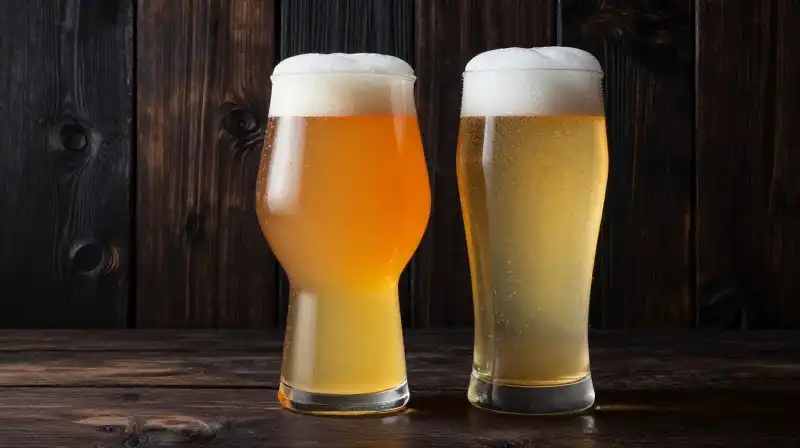
- Hazy IPAs: Characterized by a juicy, smooth mouthfeel and low perceived bitterness, often emphasizing tropical and stone fruit notes.
IPAs are engineered to be bold, highly aromatic, and generally more complex than traditional lager styles.
Defining Pilsner: The Definition of Crisp Lager
A Pilsner is not just a type of lager; it is a specific style defined by a meticulous balance of crispness, clean finish, and subtle hop presence. Like all lagers, the Pilsner is crafted through cool fermentation, ensuring a clean and smooth taste. However, it is distinguished by its signature high level of delicate bitterness and often features floral notes. Pilsners are designed for maximum refreshment. They are exceptionally bright, highly carbonated, and malt-forward in a balanced way, providing a clean canvas that is less intense than an IPA but more flavorful than a basic, light lager.
IPA vs. Pilsner: A Direct Comparison
While both styles use hops, the difference in their core process (Ale vs. Lager) creates vastly different drinking experiences. | Feature | IPA (India Pale Ale) | Pilsner | | :--- | :--- | :--- | | **Fermentation** | Warm (Top-fermenting yeast) | Cold (Bottom-fermenting yeast) | | **Primary Flavor Focus** | Hop aroma, bitterness, and flavor | Crisp malt, clean finish, subtle hop bitterness | | **Flavor Profile** | Bold, aromatic, intense, complex | Refreshing, clean, crisp, balanced | | **Body/Mouthfeel** | Full, often creamy (especially Hazy) | Light, highly effervescent, thin | | **Target Experience** | Intense flavor, gustatory exploration | Refreshment, highly drinkable, food pairing |
Strength and Alcohol Content: Addressing the PAA
A frequently asked question is whether IPA is stronger than Lager. While both styles exist across a wide range of ABVs, general trends allow for a clear answer regarding expected intensity. Generally, **IPA tends to have a higher alcohol content** than typical Pilsners or standard lagers. While a classic Pilsner typically sits between 4% and 5.5% ABV, many IPA styles range from 5% up to 7.5% or higher. * IPA (High ABV): Often between 5% and 7.5%+ ABV. High ABV is frequently linked to the high amount of malt and hops used in the brewing process. * Lager/Pilsner (Lower ABV): Generally lower, often hovering between 4% and 5.5% ABV. * Key Takeaway: While volume matters, the perception of “strength” is often tied more closely to the *flavor intensity* (the high IBUs/bitterness of an IPA) rather than just the alcohol percentage.
Choosing Your Style: Practical Decision Criteria
The choice between an IPA and a Pilsner should align with your desired drinking scenario—are you seeking intense flavor, or maximum refreshment? If you are looking for:
- Intensity and Aroma: Choose an IPA. These beers deliver a powerful, bold flavor that demands attention. They are excellent for pairing with complex, spicy, or robust dishes.
- Crispness and Cleanliness: Choose a Pilsner. This is the ideal beer for hot weather, as its light body and carbonation offer a clean, thirst-quenching refreshment. They pair exceptionally well with grilled, fried, or savory fare.
- Depth and Complexity: IPA offers the complexity through hop varieties; Pilsner offers complexity through its specific malt balance and highly refined lagering process.
The Verdict: What to Look For
When seeking a beer, understand that the fermentation process is the ultimate arbiter of its character. If a beer highlights bold, aromatic, and sometimes aggressive hop flavors, it is built on the Ale foundation (likely IPA). If the beer is defined by its smoothness, bright clarity, and clean, crisp taste, it is built on the Lager foundation (like a Pilsner). Ultimately, both styles represent the pinnacle of their respective traditions—one celebrating explosive flavor, the other perfecting elegant refreshment.
Frequently Asked Questions
Is lager stronger than IPA?
Generally, IPA tends to have a higher alcohol content than typical lagers, with many IPA styles ranging from 5% to 7.5% or higher. Conversely, classic lagers and Pilsners generally hover in a lower range, typically between 4% and 5.5% ABV.
Is IPA or pilsner stronger?
Generally, IPA tends to have a higher alcohol content than typical Pilsners or standard lagers. While a classic Pilsner typically sits between 4% and 5.5% ABV, many IPA styles range from 5% up to 7.5% or higher.
Is IPA stronger than lager?
Generally, IPA tends to have a higher alcohol content than typical lagers. While classic Pilsners typically sit between 4% and 5.5% ABV, many IPA styles range from 5% up to 7.5% or higher.
Related Articles