
How Does Pool Chalk Improve Your Shot and Cue Grip?

Introduction
Pool chalk is an essential, specialized tool in billiards, designed not merely to obscure the cue tip but to fundamentally enhance the interaction between the cue and the cue ball. Its primary function is to introduce controlled friction and manage moisture, resulting in a more consistent and predictable shot. Without proper chalk application, the energy from the cue may not be transferred efficiently into the ball, leading to slips and inaccurate spin. By understanding exactly how and where to apply this granular material, players can stabilize their movements and achieve superior shot accuracy, whether aiming for perfect center hits or generating specific spin.
The Dual Mechanics of Pool Chalk Grip
Pool chalk serves two distinct, yet complementary, purposes on the pool stick. It is important to differentiate between its application on the cue tip and its function on the player’s hand.
Increasing Friction on the Cue Tip
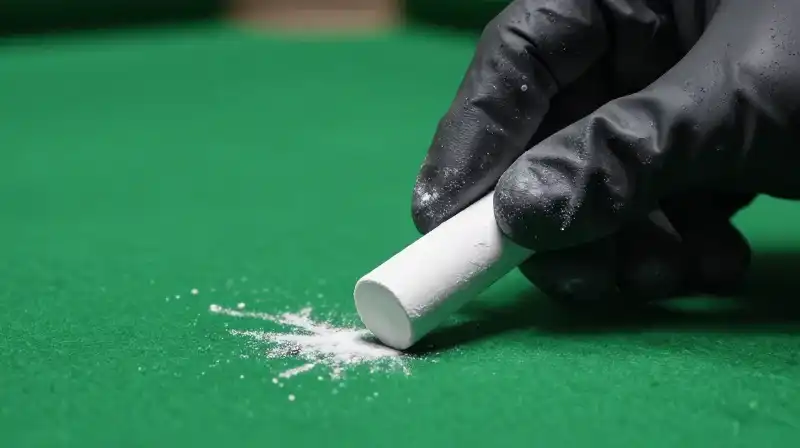
The majority of pool chalk is used on the cue tip. This gritty substance, typically formulated with silica, serves as a highly effective adhesive surface. When the cue tip makes contact with the cue ball, the chalk prevents the tip from momentarily sliding off the ball, a phenomenon often called “slipping.” This secured contact is what allows the player to impart precise backspin, sidespin (English), or a straight, powerful strike. By eliminating slippage, the kinetic energy and rotational force applied by the cue are transferred directly into the cue ball, ensuring the ball moves toward the intended target.
Controlling Moisture on the Bridge Hand
The second, often overlooked application is on the player’s bridge hand. This is known as hand chalk. Its function is purely dermatological and mechanical: it absorbs sweat and moisture from the skin. Excessive moisture on the bridge hand can decrease friction between the hand and the cue, causing the cue to slip or wobble during the backswing or stroke. Hand chalk ensures a consistent, dry interface, allowing for stable, reliable cue movement throughout the shot.
How Chalk Improves Shot Accuracy and Spin Control
The real benefit of using pool chalk is not simply about keeping the cue from slipping, but about transforming imprecise power into precise movement.
Mitigating Aiming Errors
When friction is high due to chalk, the shot becomes more forgiving. Minor inconsistencies in the player’s aim or stroke—which would otherwise result in the cue tip momentarily sliding and throwing the ball off-line—are minimized. The grip provided by the chalk allows for a more direct and controlled path, making the shot travel straight and true toward the designated pocket.
Facilitating Spin Application
To successfully execute spin, or “English,” the cue tip needs to grip the cue ball firmly while applying tangential force. If the tip slides, the spin application is erratic. The grip provided by chalk allows players to maintain a specific angle of contact, enabling them to apply controlled amounts of backspin (which affects how the ball rolls upon hitting a rail) or sidespin (which guides the ball laterally).
Optimal Usage and Maintenance Guide
Achieving maximum benefit from pool chalk depends entirely on technique and maintenance.
The Application Standard
For the cue tip, players should apply a thin, even layer of chalk immediately before every shot. The goal is coverage, not a thick mound. An overly heavy application creates excessive residue that can interfere with the ball’s smooth rolling motion and reactions, leading to unpredictable results. A light, consistent dusting is ideal.
Essential Cue Maintenance
Chalk’s benefits are only as good as the cue it is applied to. To ensure the grip works optimally:
- Keep the cue tip in excellent condition. A worn or chipped tip will not hold the chalk effectively.
- Ensure the chalk is properly applied to maintain a consistent, clean surface area.
Can You Play Pool Without Chalk? (Limits and Alternatives)
While it is certainly possible to play pool without chalk, especially in casual settings, the consistency and level of control you can achieve will be significantly reduced. When relying solely on friction from the natural cue tip material, the lack of controlled grip makes the stroke highly dependent on the player’s strength and touch. A slight imbalance or sweaty hand can dramatically alter the shot. Pool chalk is generally considered an indispensable tool for serious players because it provides a reliable layer of insurance against human and environmental variables, ensuring consistency between practice and competition.
Summary of Key Takeaways
Pool chalk is much more than a surface coating; it is a control mechanism. By using pool chalk, you are increasing the contact friction between the cue tip and the cue ball, which translates directly into better shot control, more accurate aim, and the ability to consistently apply desired spin. Furthermore, using hand chalk prevents cue slippage due to moisture. While not strictly necessary, its consistent use is the most straightforward way to optimize performance and ensure reliable ball movement.
Frequently Asked Questions
How does chalk improve pool shots?
Pool chalk enhances shots by increasing friction between the cue tip and the ball, preventing slippage and allowing players to apply controlled spin and achieve more accurate aim. Furthermore, hand chalk manages moisture on the bridge hand to ensure a consistent, stable interface and reliable cue movement throughout the shot.
Can you play pool without chalk?
Yes, it is certainly possible to play pool without chalk, especially in casual settings, though the consistency and level of control achieved will be significantly reduced. Relying solely on the natural cue tip material makes the shot highly dependent on the players strength and touch.
How to Apply and Maintain Pool Chalk
Ensure Cue Tip Condition
Check that the cue tip is in excellent condition, as a worn or chipped tip will not hold the chalk effectively.
Apply Chalk to Cue Tip
Immediately before every shot, apply a thin, even layer of chalk to the cue tip. The goal is coverage, not a thick mound.
Maintain Application Standards
Ensure the chalk is properly applied and maintained to maintain a consistent, clean surface area for optimal grip and function.
Related Articles