
Scotch vs. Whisky: Defining the Distinctions in Origin and Grain

Introduction
The simple answer to “Is Scotch the same as whiskey?” is no. While Scotch is a specific *type* of spirit, it falls under the expansive umbrella of what is globally referred to as whisky or whiskey. The primary difference lies not in the process of distillation itself, but in strict, legally protected rules concerning geographical origin, required aging, and specific production methods. To understand the distinction, one must view whisky as the broad category, and Scotch as a defined sub-category that must meet certain stringent standards set by Scottish law.
Whisky vs. Whiskey: The Global Terminology
The confusion between “Whisky” and “Whiskey” stems from a historical geographical split rather than a functional difference in the spirit itself. This distinction is highly relevant when discussing global regulations:
- Whisky: This is the standard spelling used primarily in Scotland, Canada, Japan, and the European Union. It is the globally accepted term for the spirit.
- Whiskey: This spelling is the standard in the United States, Ireland, and the majority of the American market.
For the purpose of understanding the comparison, “whisky” is the most accurate term for the broad category of any spirit distilled from fermented grains (barley, rye, corn, wheat). All Scotch is whisky, but whisky made in Ireland, America, or Jamaica is not Scotch.
Defining Scotch: The Legal Mandate of Origin
Scotch whisky is defined by three specific legal requirements that distinguish it from nearly every other spirit on the market. It is not simply “whisky made from barley.”
- Geographic Constraint: Scotch must be produced within Scotland. This is the most critical differentiator. A spirit brewed elsewhere, even with the same grain and aging process, cannot be legally labeled as Scotch.
- Malt Requirement: Traditional Scotch is typically distilled from malted barley, although some grain whisky is permitted.
- Minimum Age: For most single malt or blend expressions, the spirit must be matured in oak casks for a minimum of three years.
Because of these protected regional laws, Scotch carries a prestige tied directly to its origin and adherence to these specific production methods, much like how a French wine must come from specific regions.
Beyond Scotland: Understanding Comparative Whiskies
To truly grasp what makes Scotch unique, it helps to compare it against other major whisky styles that operate under different, localized laws:
| Style | Primary Region | Defining Characteristic | Typical Grain Requirement |
|---|---|---|---|
| Scotch | Scotland | Geographical origin; minimum 3 years aging. | Malted Barley |
| American Whiskey (Bourbon) | USA | Federal laws; must be aged in new, charred American oak. | Min. 51% Corn |
| Irish Whiskey | Ireland | Known for its smoothness and triple distillation process. | Varies (often Malted Barley) |
| Rye Whiskey | USA | Defined by high rye content (min. 51%); typically spicy and dry. | Rye |
The Flavor Impact: Distillation and Cask Selection
While the grain is the starting point, the character of the final spirit is shaped by two primary factors: the method of distillation and the type of cask used for aging.
The Role of Grain
The choice of grain dictates the foundational flavor profile. Corn in Bourbon lends a sweetness and full body. Rye adds spice and dryness. In contrast, the barley used in Scotch, particularly when malted, provides the characteristic earthy, sweet, or malty base.
Distillation and Peat
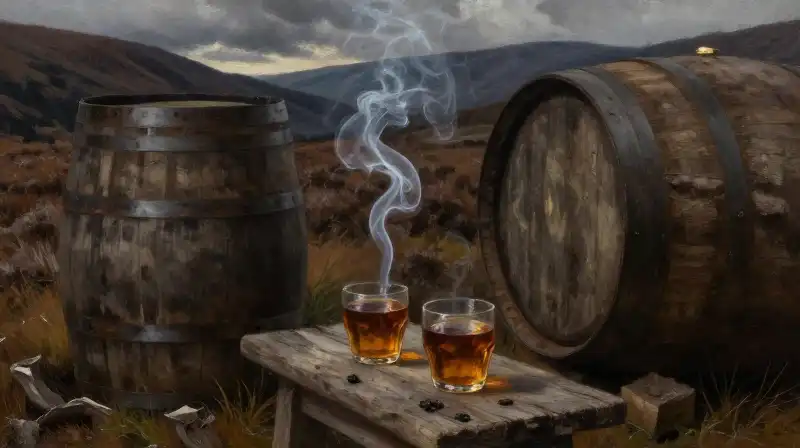
One hallmark of many Scotch whiskies is the use of peat during the distillation process. Peat imparts a smoky, earthy, and often medicinal character (most famously in regions like Islay). This smoky profile, a result of burning peat rather than the wood of the barrel, is a hallmark of specific Scotch sub-regions.
The Cask Connotation
The aging vessel significantly impacts the final taste:
- Bourbon uses new, charred American oak barrels, contributing notes of vanilla, caramel, and sweetness.
- Scotch often uses wood that has already held other spirits (second-generation casks like ex-sherry or ex-bourbon), allowing the spirit to absorb flavor without overpowering it.
Deciding on Your Next Pour: Practical Criteria
To resolve the question of which spirit is “better,” focus less on the term and more on the flavor profile and desired experience.
- If you prefer a sweet, robust flavor: Lean toward Bourbon, which is characterized by its high corn content and round, full body.
- If you want complex smoke and coastal earth: Opt for a peated Scotch, typically from regions like Islay.
- If you seek a smooth, less intense character: Try an Irish whiskey, which is triple-distilled to achieve a notably velvety finish.
- If you desire a spicy, dry finish: Look for Rye whiskey, whose high rye percentage provides distinct peppercorn and dry spice notes.
- If you want traditional, multi-regional blends: A Blended Scotch Whisky is the most versatile choice, offering a balanced flavor mix from various distilleries.
Synthesis: Avoiding Common Misconceptions
The most frequent error regarding these spirits is conflating the term “Whisky” with the geographical origin of “Scotch.” Remember that “whisky” is the universal term for the spirit category, while Scotch is a specific, legally protected designation tied solely to its Scottish roots. Do not assume a whiskey labeled ‘premium’ is a Scotch. Evaluate the spirit based on its source, its regional characteristics (Is it spicy, peaty, sweet?), and its legal labeling rather than the general name of the spirit.
How to Select the Right Whisky Based on Flavor Profile
Determine Desired Flavor Profile
Identify whether you prefer a sweet, robust, complex, smooth, or spicy and dry character.
Match Preference to Spirit Type
If you prefer sweet and robust, lean toward Bourbon. If you want complex smoke and coastal earth, opt for peated Scotch (e.g., Islay). If you seek a smooth character, try Irish whiskey (triple-distilled). If you desire a spicy, dry finish, look for Rye whiskey. If you want traditional multi-regional blends, select Blended Scotch Whisky.
Related Articles