
How Smart Are Sheep? Their Remarkable Memory and Social Intelligence

Introduction
Sheep are often stereotyped as docile, simple grazers, yet scientific research reveals a level of cognitive complexity that challenges the popular notion that they are unintelligent. While the concept of animal intelligence requires specific metrics, studies suggest that sheep possess notable cognitive abilities, particularly in areas of memory, complex social bonding, and environmental awareness. Contrary to the assumption of being merely “dumb,” sheep exhibit traits that indicate they are highly social, deeply emotional, and remarkably perceptive. Their intelligence is best understood not through a single test score, but through the sophistication of their social dynamics and their ability to process a complex world.
Facial Recognition and Superior Memory
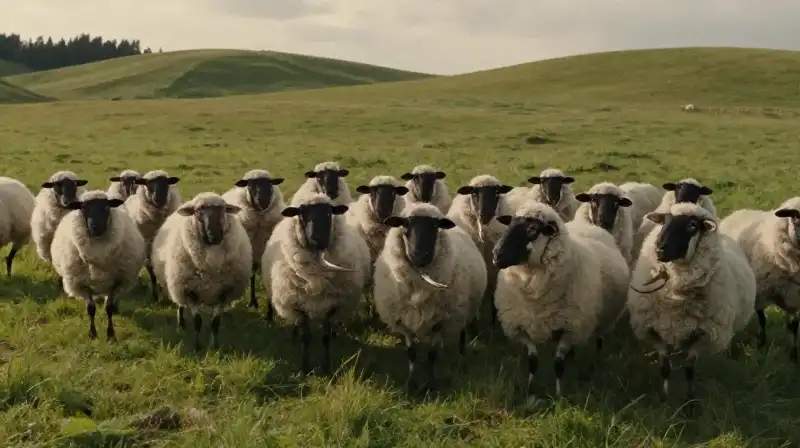
One of the most compelling arguments for the intelligence of sheep lies in their memory and ability to process individuality. Research demonstrates that sheep are capable of recognizing, differentiating, and remembering the faces of both humans and other flock members. A single sheep can retain the memory of dozens of flock-mates and at least ten human faces over extended periods. This recognition is not random; it follows a predictable cognitive process. Sheep initially analyze faces by focusing on external features such as the outline, the shape of the ears, and the hair pattern. Only when they become familiar with a specific individual do they shift their attention to recognize subtle internal characteristics. This detailed cognitive mapping showcases a high degree of neural processing. Furthermore, their excellent memory capabilities are complemented by unique anatomical features, specifically their rectangular pupils. This pupil shape enables a 270 to 320-degree field of peripheral vision, providing an expansive awareness of their surroundings that supports sophisticated recognition and safety behaviors.
The Depth of Social Intelligence and Emotion
The social structure of a flock requires complex communication and empathy, traits strongly associated with high intelligence. Sheep do not operate in isolation; they engage in intricate social processes. They are capable of forming deep, lasting bonds with companions and are known to exhibit grief and profound attachments following the loss of a mate. Their social intelligence extends to protecting one another. Sheep actively display self-protective social behaviors, such as standing up for a conflicted member of the flock. Furthermore, flock dynamics often involve a degree of “collective intelligence.” Within a group, sheep participate in fluid social processes, sometimes electing temporary leaders to guide the group’s movements. This suggests that their intelligence functions not just individually, but also through complex communal decision-making. Their emotional range is surprisingly broad, encompassing happiness, boredom, fear, and even observable signs of stress, indicating a robust capacity for feeling and processing internal states.
Cognition, Instinct, and Selective Breeding
It is crucial to understand that animal intelligence is multifaceted and heavily influenced by context. While sheep demonstrate high-level cognitive abilities, their intelligence exists alongside strong, natural instincts. Domestication, which began approximately 11,000 years ago, has certainly refined certain aspects of their behavior. Genetic factors and environment play a defining role. Selective breeding has influenced traits like the number of breeds (over 200 distinct types exist globally) and physical prowess. However, environment also dictates how intelligence manifests. Studies suggest that the cognitive capacity of domesticated animals is enhanced or redirected by their surroundings. Even exhibiting “cunning” behaviors, such as successfully escaping containment, proves that their complex intelligence isn’t limited to simple livestock management; it is a function of their problem-solving abilities when faced with novel environmental challenges.
Sheep Are Smart: Comparative Ability and Practical Context
When asked “how smart are sheep compared to humans,” the most accurate answer is that their intelligence is highly specialized. They lack the abstract reasoning or language capacity of humans, but within the scope of farm and animal husbandry, their cognitive abilities rank among the highest. The term “smart” for a sheep refers to: * **Social Acuity:** The ability to navigate complex, fluid social hierarchies and maintain lifelong bonds. * **Perceptual Power:** Utilizing broad peripheral vision and advanced facial recognition. * **Emotional Depth:** Experiencing a wide spectrum of emotions, including grief. Sheep intelligence is best assessed against other species in their own niche. Research comparing them to other farm animals like pigs suggests they possess remarkably high cognitive metrics for their classification. Their capacity to recognize and adapt to their social environment firmly places them in the “high-intelligence” category for livestock.
Navigating the Nuances: Limits and Exceptions
Understanding sheep intelligence involves acknowledging its limits. While their memory and social skills are robust, they lack the capacity for complex human abstraction. However, this does not diminish their overall cognitive power. There are several nuances to consider when evaluating sheep’ behavior:
- Instinct vs. Intellect: A sheep’s strong maternal instincts or flight responses are evolved survival mechanisms, not necessarily products of learned intelligence.
- Measurement Dependence: Sheep intelligence fluctuates depending on the cognitive test used. A task requiring memory will show high performance, while one requiring abstract mathematics would not.
- Environmental Impact: In poorly managed or confined environments, even intelligent sheep can exhibit negative behavioral patterns or stress-related behaviors.
Synthesizing Sheep Intelligence
Sheep are far more intelligent than they are frequently perceived to be. The prevailing misconceptions about sheep being simple or unintelligent fail to account for their sophisticated social structures, their remarkable capacity for facial recognition, and their profound emotional lives. Their intelligence is not defined by human intellectual benchmarks, but by the complexity of their interactions, their capacity for detailed recall, and their ability to maintain deep, lasting connections. Recognizing these traits helps us appreciate the profound cognitive abilities of this essential part of global biodiversity.
Related Articles