

AAA Battery Voltage: The Guide to 1.5V Cells and Series Wiring

Introduction
The standard nominal voltage of a single AAA (Triple-A) battery is 1.5V, but the actual voltage produced and the capacity of the battery depend heavily on its chemical composition and how it is used. When determining the necessary power for an electronic device, simply knowing the cell type is not enough; you must understand the difference between voltage (electrical potential) and capacity (total energy storage). AAA batteries are defined by their physical size—small, dry cells intended for low-drain, portable electronics like remotes and digital cameras. While the size “AAA” refers only to its dimensions (10.5 mm diameter, 44.5 mm length), its electrical performance is determined by its internal chemistry and how you connect multiple cells.
Chemistry and the Nominal Voltage of AAA Cells
The nominal voltage of a AAA cell is not a fixed, absolute number across all brands or types. Instead, it is dictated by the chemical reaction occurring inside the battery during discharge.
Primary vs. Secondary Chemistries
A common point of confusion is assuming all AAA batteries are the same. They fall into two primary categories based on whether they can be recharged:
- Primary (Disposable) Batteries: These include standard alkaline and primary lithium cells. They generally maintain a strong nominal voltage of 1.5V throughout their useful lifespan. They are designed for a single use until the chemical energy is exhausted.
- Secondary (Rechargeable) Batteries: These commonly use chemistries like Nickel–Metal Hydride (NiMH) or Nickel–Cadmium (NiCd). These batteries typically have a lower nominal voltage, usually around 1.2V, because the recharge cycle alters the internal cell potential compared to a fresh alkaline cell.
Specialized Battery Types
While 1.5V is the standard for most consumer AAA applications, specialized rechargeable or lithium-ion AAA cells (such as those used in certain high-performance toys) might display a consistent nominal voltage of 1.5V throughout the discharge cycle, or slightly higher, depending on their internal configuration.
How to Increase Voltage: Series Wiring
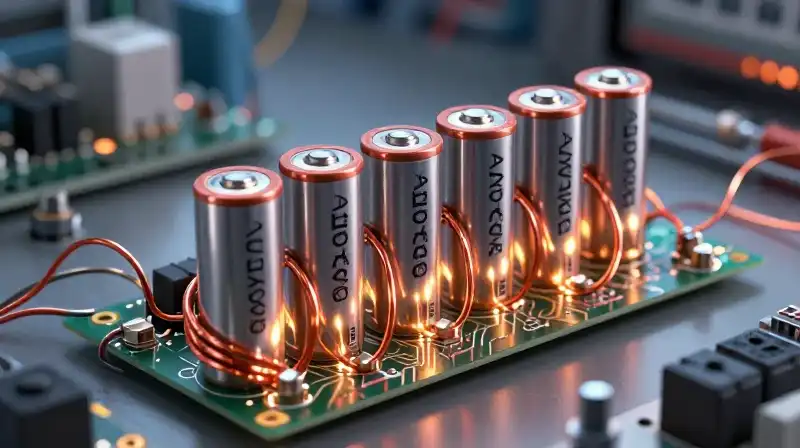
Most small consumer devices (like remote controls) only require the inherent 1.5V of a single cell. However, if a device—such as a small LED panel or a specific piece of technical gear—requires 3V, 4.5V, or more, you cannot simply increase the size of the AAA battery. You must use series wiring. Series wiring involves connecting the positive terminal of one cell to the negative terminal of the next. In electrical terms, you are adding the voltage of each individual cell together.
- Two AAA batteries wired in series produce 3.0V (1.5V + 1.5V).
- Three AAA batteries wired in series produce 4.5V (1.5V + 1.5V + 1.5V).
This mechanism increases the total electrical potential difference, allowing the system to drive more power, but it does not change the individual characteristics or chemistry of the batteries themselves.
The Role of Parallel Wiring (Capacity Boost)
If your device is already receiving the correct operational voltage but needs the power to last longer, the solution is parallel wiring. Parallel wiring means connecting all the positive terminals together and all the negative terminals together. This configuration does not increase the voltage; the output remains the nominal 1.5V. Instead, it combines the capacity (the “charge reserve”) of each battery. If you connect two 1.5V AAA cells in parallel, the device still receives 1.5V, but it now has double the total energy to run for twice as long.
AAA vs. AA: Capacity vs. Raw Power
A frequent question is whether an AA battery is inherently “more powerful” than a AAA battery. The answer is no. They are fundamentally the same technology (chemical cells) scaled differently. The primary difference is size and capacity:
| Feature | AAA Battery | AA Battery | Implication |
|---|---|---|---|
| Size (Volume) | Small | Larger | Allows for greater internal active material. |
| Capacity | Lower | Higher | AA batteries can store and deliver more total charge for longer. |
| Voltage | Nominal 1.5V (Primary) | Nominal 1.5V (Primary) | The starting voltage is the same regardless of size. |
| In summary, choosing an AA over a AAA provides more “fuel” (capacity), but it does not inherently provide a higher operating voltage. Voltage is determined by the cell’s chemistry, not its diameter. |
Evaluating Battery Health and Voltage Drop
Checking the voltage of a AAA battery using a multimeter is the most accurate way to determine its functional health. A battery’s voltage does not remain constant during use; it drops as the chemical reactions deplete the stored energy. * Full Charge: A healthy primary AAA battery should measure around 1.5V. * Minimal Functional Charge: Most batteries maintain useful operation until their voltage drops to approximately 1.3V. * Failure: Once the voltage drops significantly below 1.2V, the battery is nearing the end of its life, regardless of how much physical charge it still holds. When dealing with rechargeable AAA batteries (NiMH), voltage can be more variable due to the efficiency and temperature of the charging cycle.
Practical Guide to High-Drain Devices
For devices that draw a high amount of current (amperage), the simple voltage and capacity figures are insufficient. High-drain use stresses the battery’s internal resistance and heat tolerance.
Consider Internal Resistance
While series wiring increases voltage, it can also put more stress on the internal chemistry. All cells have an internal resistance. In a series circuit, the internal resistance of each cell is added together, which can lead to greater voltage drop and premature failure if the device draws more current than the chemistry can sustain.
Decision Criteria for Selection
To avoid confusion when buying batteries for a specialized device, evaluate these factors:
- Required Operating Voltage: Does the device require 1.5V, 3V, or 4.5V? (If 3V, use two cells in series).
- Required Runtime: If the voltage is correct, use parallel wiring or larger capacity cells (like AA) for longer operation.
- Discharge Rate: For high-power tools or electronics, ensure the chosen chemistry is rated for the required amperage to prevent overheating and sudden voltage collapse.
Practical awareness of these dynamics ensures that you are choosing a battery configuration that meets both the electrical demands and the lifespan expectations of the device.
How to Select the Optimal AAA Battery Configuration for Your Device
Determine Operating Voltage Requirement
Identify whether your device requires 1.5V, 3V, or 4.5V. If multiple cells are needed, use series wiring to achieve the required total voltage (e.g., two cells in series for 3V).
Determine Required Runtime
If the voltage matches the device needs, prioritize runtime by using parallel wiring or substituting larger capacity cells, such as AA batteries, to maximize energy reserves.
Evaluate Discharge Rate
For high-power tools or electronics, ensure the chosen battery chemistry is rated for the required amperage to prevent overheating, excessive voltage drop, and premature failure.
Related Articles