

AWD Car Towing Guide: How to Prevent Drivetrain Damage

Introduction
Towing an All-Wheel Drive (AWD) or four-wheel drive (4x4) vehicle is significantly more complex than towing a standard two-wheel-drive car. Because the AWD system connects all four wheels to a single powertrain, improper movement can put excessive torque and strain on the transmission, transfer case, and driveshafts. Ignoring the manufacturer’s specific requirements risks severe and expensive mechanical damage. While various methods exist—from flatbed trailers to carefully controlled flat-towing—the safest practice is always to keep the drivetrain components entirely static or minimize their operational load. This guide provides the specialized procedures and critical warnings necessary to transport an AWD vehicle without risking its complex mechanical integrity.
The Flatbed vs. Flat Tow Comparison
The fundamental decision in AWD towing is between methods that completely disconnect the vehicle’s drivetrain from the road and those that rely on minimal motion.
Flatbed and Trailer Towing (The Gold Standard)
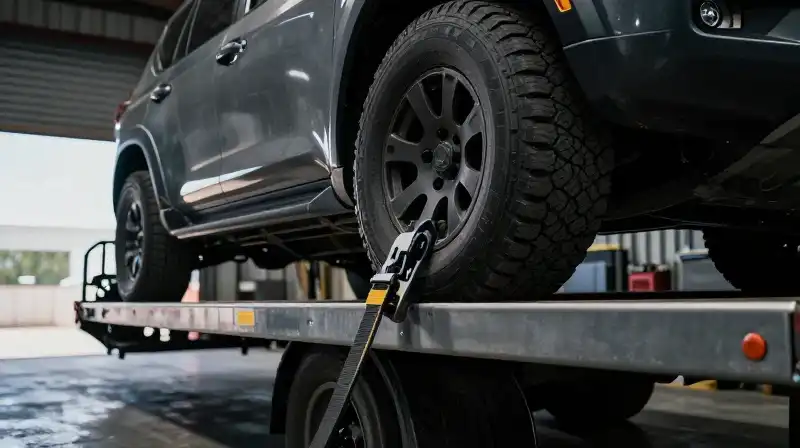
For most AWD vehicles, especially those with complex, modern, or automatic drivetrains, a flatbed tow truck or trailer remains the safest and most universally recommended method. In this scenario, the vehicle is entirely supported by the frame, and the wheels do not contact the ground for most or all of the journey.
Why it is best: This method prevents the transfer case and differentials from receiving load. It eliminates the risk of excessive heat and wear that occurs when internal drive components are rotating while being towed. Flatbed towing is the recommended choice for long-distance transport.
Flat Towing and Neutral Mode
When a flatbed is not an option, moving the vehicle forward with all four wheels on the ground—known as flat towing—is possible but requires strict adherence to conditions. This method demands that the vehicle be in neutral (N) or the specific neutral gear permitted by the manufacturer’s transfer case.
Key Restrictions and Risks: This method is only suitable for very short distances. Excessive speed or distance can still induce stress. Always confirm that your specific model allows this procedure; many AWD systems are not designed to function this way while rolling.
| Method | Wheel Contact | Drivetrain Stress | Recommended Use | Safety Rating |
|---|---|---|---|---|
| Flatbed / Trailer | Minimum / None | Minimal | Long-distance transport | Highest |
| Flat Tow (Neutral) | All Four | Moderate (if stressed) | Short distances only | Medium |
| Wheel Lift / Dolly | Limited (2-3) | High | Very specific situations | Low / Specialized |
Critical Pre-Towing Inspection and Disconnection
Before any motion begins, the primary objective is to ensure the drivetrain cannot send rotational power through the wheels. Simply putting the vehicle in neutral may not be sufficient.
Consult the Owner’s Manual: This is the most crucial step. Towing requirements vary drastically between different vehicle types and even different trims. The “Disabled Vehicle Towing” section of your owner’s manual contains the definitive, manufacturer-tailored instructions. Relying on general advice over the manual is a direct path to component damage.
- Check for Drive Disengagement: Determine if the transfer case requires a manual shift into a non-driving mode or if the transmission automatically disengages when in neutral.
- Evaluate Driveshaft Requirements: In some 4WD configurations, specialized components (like driveshafts or connecting knuckles) may need to be manually disconnected before towing. Attempting to tow with the drivetrain engaged significantly increases the risk of internal failure.
- Verify Dolly Compatibility: If you are considering a dolly (lifting two wheels), confirm in the manual that the AWD system is compatible with this type of transport. Dolly towing is highly specific and not a standard solution for most modern AWD vehicles.
Flat Towing Limits: Speed and Distance
If flat towing is the unavoidable choice, staying within established safety margins is essential to prevent excessive heat and mechanical strain. These limitations are based on minimizing load on the powertrain during movement.
Speed Restriction: To prevent component stress, AWD vehicles should generally not exceed a maximum speed of 35 mph (56 km/h) when flat towing. Do not exceed this speed.
Distance Limitation: For flat-towing on public roads, the recommended maximum distance is typically 50 miles (80 km). Beyond this limit, the cumulative stress on the components becomes a significant concern.
Potential Pitfalls: What Happens If You Tow Improperly?
Improper towing does more than just delay repairs; it often causes hidden damage that manifests later.
Drivetrain Failure: Moving an AWD car while the drivetrain is engaged forces the transfer case and transmission to operate without the cooling and lubrication parameters designed for road driving, leading to overheating and accelerated wear. This can cause failure of internal gears or couplings.
Mechanical Symptoms: Damage resulting from incorrect towing may not be immediate. You might experience sudden mechanical noises, unusual vibrations, or strange electronic system errors long after the transport is complete, often pointing to a failure in the torque converter or transmission bell housing.
Final Synthesis: The Decision Matrix
When faced with towing an AWD vehicle, prioritize the following based on your specific situation:
- Long Distance: Opt for a flatbed or trailer to completely bypass the drivetrain.
- Short Distance (Emergency): Confirm the vehicle’s manual allows flat towing in neutral (N), adhering strictly to the 35 mph/50-mile limits.
- Total Confusion: If the manual is unclear or you cannot find a definitive statement on the required towing method, seek professional assistance from a towing service specializing in AWD vehicles.
Always remember that the definitive guide is the vehicle’s owner’s manual. When in doubt, choose the method that keeps the drivetrain static.
Frequently Asked Questions
How do AWD cars get towed?
Most AWD vehicles are safely towed using a flatbed or trailer to prevent strain on drivetrain components. Alternatively, flat towing is possible if the vehicle is in neutral and adheres to strict limits of 35 mph and 50 miles.
How should all wheel drive be towed?
The safest and most universally recommended method for most AWD vehicles is to use a flatbed tow truck or trailer to entirely bypass the drivetrain. If flat-towing is necessary, the vehicle must be in neutral and adhere strictly to the 35 mph/50-mile limitations, but the owners manual must always be consulted for specific instructions.
How to Properly Tow an All-Wheel Drive (AWD) Vehicle
Consult the Owner’s Manual
Begin by consulting the vehicle's owner’s manual, specifically the “Disabled Vehicle Towing” section, as towing requirements vary drastically by vehicle type and trim.
Evaluate Drive Disengagement
Determine if the transfer case requires a manual shift into a non-driving mode or if the transmission automatically disengages when in neutral.
Verify Driveshaft Requirements
Check if specialized components (like driveshafts or connecting knuckles) need to be manually disconnected before towing, especially in certain 4WD configurations.
Confirm Dolly Compatibility (If applicable)
If considering a dolly (lifting two wheels), verify in the manual that the AWD system is compatible with this type of transport, as it is not a standard solution for most modern AWD vehicles.
Adhere to Flat Towing Limits
If flat towing is used, ensure the vehicle does not exceed 35 mph (56 km/h) and generally do not exceed 50 miles (80 km) to prevent excessive heat and mechanical strain.
Related Articles