
Are Ants Strong? The Scientific Explanation of Proportional Power

Introduction
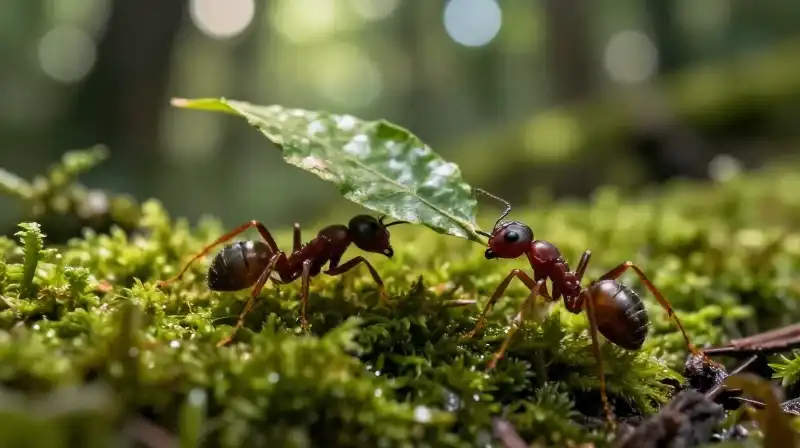
The question of whether ants are strong—and why some often appear to be—requires an answer that moves beyond simple observation and delves into the mechanics of biology and physics. If the definition of strength is measured by the absolute weight a creature can lift, then a human can certainly lift more weight than an ant. However, when researchers analyze strength by the capacity relative to the organism’s total body mass, a different, profound truth emerges: ants are proportionally one of the strongest creatures on Earth.
The seemingly “impossible” feat of an ant lifting many times its own body weight is not due to muscles possessing inherent, supernatural power. Instead, it is a function of evolutionary efficiency and the mathematical principles of biological scaling. The core of this phenomenon is the Square-Cube Law, a principle that dictates how physical dimensions influence mass and strength in scaling objects. Understanding this law is the key to understanding why a tiny ant, despite its size, exhibits such an astonishing strength-to-mass ratio.
The Square-Cube Law: The Physics of Scaling
The Square-Cube Law describes the relationship between an object’s volume and its surface area as its size increases. Simply put, as an object gets larger, its volume—and consequently its mass—increases exponentially faster than its surface area. For a creature, this has major implications for how biological structures function.
Strength in a living organism is directly related to the cross-sectional area of its muscles (a squared relationship). But mass (the weight it must carry) increases in three dimensions (cubically). When a creature scales up, its mass increases rapidly, but the size of its lifting muscles—while growing—cannot keep pace with the increase in body volume. This disparity results in a decline in the strength-to-mass ratio as organisms get larger. A giant insect or a massive mammal is inherently less efficient at moving its own mass than a small, compact creature like an ant.
Proportional vs. Absolute Power: Ants vs. Giants
When comparing an ant to a large mammal, the comparison is flawed if you only consider absolute weight. The ant’s capability is defined by its proportional load-carrying efficiency, which sets it apart from larger species like elephants or humans.
Here is how the comparison functions when evaluating proportional strength:
- The Ant’s Efficiency: Because of its compact shape and high surface area-to-volume ratio, an ant can maintain a high strength-to-mass ratio. They can carry loads estimated up to 20 times their own body weight. Their muscular systems are structured to maximize work capacity relative to their minimized weight.
- The Large Mammal’s Limitation: Humans and elephants, while possessing vastly greater absolute strength, have a significantly lower strength-to-mass ratio. The sheer volume of tissue and bone that must be moved means that a larger percentage of the total effort goes toward moving bulk rather than maximizing the payload carried relative to body size.
In essence, the ant does not possess “super strength” compared to a human in terms of sheer lifting capability; rather, the ant is profoundly stronger in a relative, proportional sense. Its ability to maintain that ratio is what constitutes a physically superior feat.
Anatomical Advantages of the Insect Body
The ant’s ability to thrive under these physics is supported by unique anatomical features that benefit its load-bearing mechanics. These structural elements further reduce the stress on the musculature and enhance weight distribution.
Exoskeleton as Structural Support: Unlike internal human skeletons, the ant possesses an external skeleton. This exoskeleton provides rigid, external support that allows the exoskeleton to distribute weight across the body. This drastically reduces the mechanical stress on the muscles, allowing them to generate maximum force without sustaining structural failure under heavy loads.
Surface Area and Leverage: The small, streamlined body of the ant provides a large surface area relative to its volume. This optimized physical structure allows for highly efficient mechanical leverage during the lifting motion. The relationship between muscle power and surface area is a key characteristic of many insects, enabling superior movement in their size class.
Limits and Nuances in Measuring Ant Strength
While ants are masters of proportional strength, it is important to clarify that not all insects are equally efficient. There are other insect species that may exist which possess an even higher strength-to-mass ratio.
Furthermore, the definition of strength must account for other factors beyond simple mass lifted. When evaluating the comparative capabilities of species, one must consider the practical outcome of “work capacity”—the mass moved divided by the distance covered. For an ant, the combination of low weight, high muscular efficiency, and structural integrity allows for powerful and sustained mechanical work that larger, heavier species cannot replicate under comparable proportional constraints.
Defining Strength: Practical Conclusions
To summarize the findings, the answer to the question “Are ants strong?” depends entirely on the metric of measurement. If strength is defined by absolute weight, then the ant is comparatively weak. If strength is defined by proportional capacity relative to total body mass, the ant is a biological marvel.
The ant’s power is not a biological anomaly; it is a predictable consequence of efficient physical design operating within the constraints of the Square-Cube Law. Their enduring ability to carry disproportionately heavy loads is a testament to the sophisticated relationship between biological scaling, structural efficiency, and the innate power of the small.
Related Articles