
How Airplanes Take Off: The Physics of Lift and Thrust Explained

Introduction
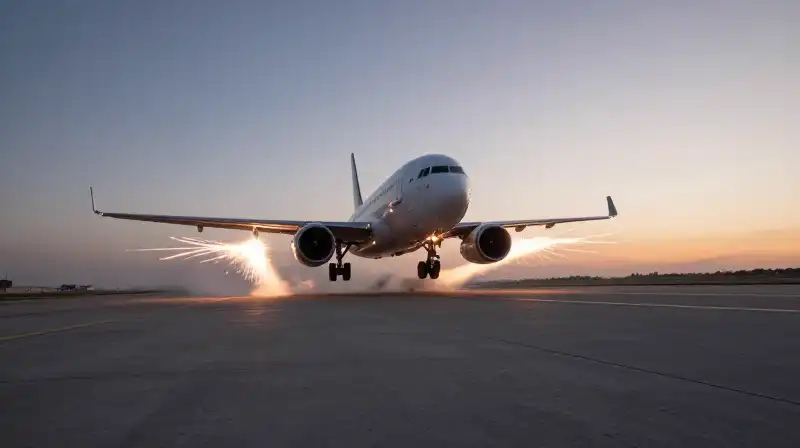
How airplanes take off is not a single action, but a rapid, precise sequence governed by fundamental laws of physics and engineering. At its core, flight relies on the ability to overcome the downward pull of gravity. This is achieved by the aerodynamic forces generated by the wings and engines. This process transforms simple forward motion into controlled vertical ascent by manipulating the air around the aircraft, balancing the four primary forces: lift, weight, thrust, and drag.
The Mechanics of Flight: Balancing Four Forces
Before examining the takeoff procedure, it is essential to understand the interplay of the forces acting on any aircraft. Lift is the upward force generated by the wings; it must be greater than weight to achieve flight. Weight is the constant downward force of gravity. Thrust is the forward power supplied by the engines, propelling the plane through the air. Finally, Drag is the resistance created by the air pushing back against the movement.
Thrust and Weight
During the runway phase of takeoff, the pilot’s primary goal is to generate enough forward momentum to overcome drag and create sufficient air speed. The engines produce thrust by following Newton’s Third Law: the engines rapidly expel gases backward, and the resulting reaction pushes the plane forward. This forward thrust is necessary to turn the stationary wing into an airfoil in motion, which is the prerequisite for lift generation. Weight, which remains constant, is the force the airplane must successfully defeat.
The Principle Behind Lift: Airflow and Pressure
Lift is generated through complex fluid dynamics, primarily governed by two interconnected theories. The most accessible explanation involves Bernoulli’s Principle. When an airplane moves, the air splits around the wing (the airfoil). The curved top of the wing forces air traveling over the upper surface to accelerate, while the air flowing beneath it continues at a slower pace. This difference in speed creates an area of significantly lower pressure on top of the wing and higher pressure beneath it. This pressure differential creates the upward force known as lift.
Complementary to this is Newton’s Third Law. The wing is expertly shaped to exert a downward force on the air as it passes over the surface. The reaction of the air pushing back against the wing generates the corresponding upward lift. For an aircraft to take off, the total upward lift force must exceed its total weight.
The Takeoff Sequence: From Runway to Rotation
The transition from ground travel to airborne flight is controlled by specific pilot maneuvers and critical speed milestones. This process is often categorized into several distinct phases.
The Build-up of Critical Airspeed (Vr)
As the aircraft accelerates down the runway, the aerodynamic forces begin to build. However, the wing’s lift is directly proportional to the square of the airspeed. This means a small increase in speed results in a disproportionately large increase in lift. Pilots monitor their speed against a predefined limit called “rotation speed,” or Vr. Vr is the minimum speed required to generate enough lift to initiate liftoff.
Initiating the Ascent: Angle of Attack
Reaching Vr is not the final step; the pilot must then physically change the wing’s geometry to maximize lift. This is done by pulling back on the controls, which commands the elevators at the tail to rotate the nose of the aircraft upward. This rotation increases the angle of attack—the angle between the wing and the incoming airflow. By increasing this angle, the wing forces even more air over its curved surface, rapidly increasing the pressure difference and maximizing lift. Lift must now be large enough to break the aircraft’s ground friction and achieve vertical movement.
The Role of Ground Effect
When a plane is close to the ground, it experiences “ground effect.” This phenomenon occurs because the airflow is compressed and redirected by the ground, creating an increase in upward pressure beneath the wings. Ground effect assists initial lift and allows aircraft to achieve a portion of the necessary lift at slightly lower speeds. However, as the aircraft leaves the immediate influence of the ground, this upward pressure drops significantly, making continued lift generation reliant solely on the dynamic forces of speed and angle of attack.
Technical Dynamics Beyond Initial Liftoff
Several factors define the performance and stability of an aircraft during and immediately after takeoff. Understanding these nuances helps explain why certain planes achieve lift more efficiently than others.
Ground Speed and Lift Efficiency
The speed at which a plane accelerates determines how quickly it can reach the “critical speed” where lift becomes greater than weight. If a runway is too short or wind conditions are unfavorable, achieving the required velocity before the end of the strip can be impossible. The engine thrust must be tuned to ensure that the generated drag does not prevent the plane from achieving sufficient airspeed.
Aerodynamic Considerations After Liftoff
Once airborne, the immediate objective is to minimize resistance while climbing. This is why aircraft are designed to retract their landing gear shortly after liftoff. The wheels, struts, and flaps are highly visible sources of drag; retract them, and the airplane becomes more aerodynamically efficient, allowing the engines to maintain necessary thrust for the climb with less required power.
Practical Synthesis: Key Factors for Understanding Takeoff
Understanding the principles of takeoff is more than knowing definitions; it is about recognizing a dynamic threshold. The success of the takeoff process is dictated by a delicate balance between engine power (Thrust), wing design and airspeed (Lift), and the aircraft’s mass (Weight), all while managing air resistance (Drag).
- Critical Speed: Takeoff is fundamentally about reaching the Vr threshold where lift surpasses weight.
- The Role of Control: While speed creates the opportunity for lift, the pilot’s use of elevators (the angle of attack) provides the specific mechanism to convert that speed into vertical force.
- Environmental Impact: Takeoff dynamics are highly sensitive to atmospheric conditions (density, wind shear), as these factors change how air flows over the airfoil, effectively changing the lift required.
- Efficiency vs. Power: The ideal takeoff balances high thrust with controlled acceleration to maximize lift generation at the lowest possible ground speed.
By viewing takeoff as the coordinated interaction between engine thrust and aerodynamic lift, the physics—specifically Bernoulli’s principle and Newton’s laws—become clear in how humanity successfully navigates the transition from the earth to the sky.
Related Articles