
Tuxedo vs. Dinner Jacket vs. Suit Jacket: Key Design Differences

Introduction
The differences between a suit jacket, a tuxedo, and a dinner jacket are primarily matters of formality, material composition, and specific tailoring details. While all three garments cover the upper body, they exist on different ends of a formality spectrum, ranging from everyday business attire to high-level black-tie galas. Simply put, the core decision lies in the event’s dress code: a blazer is casual and versatile, a standard suit is formal business attire, and a tuxedo or dinner jacket signals highly formal evening events. Understanding these nuances is key to appearing polished and adhering to event etiquette.
Distinguishing the Core Garments: Suit, Dinner Jacket, and Blazer
To accurately compare these pieces, it is helpful to first isolate their intended uses and primary characteristics.
The Standard Business Suit Jacket
A traditional suit is designed for professional or structured daytime events. It is a cohesive outfit—the jacket and trousers are cut from the same cloth—making it a highly versatile garment. Its construction is sturdy and professional, meant to convey seriousness and competence in a business or semi-formal setting. The jacket typically features conventional tailoring and utilitarian hardware.
The Tuxedo and Dinner Jacket
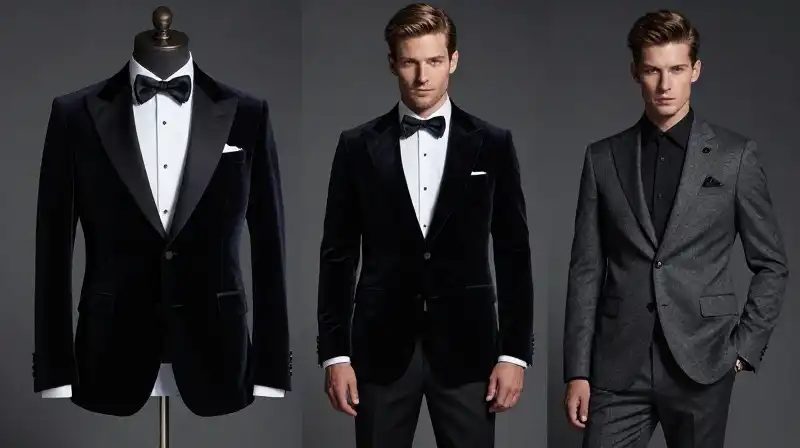
Both terms refer to formal evening wear, but “tuxedo” and “dinner jacket” have subtle but important distinctions, often used interchangeably depending on regional preference (the UK often uses “dinner suit” or “dinner jacket” while the US uses “tuxedo”). A tuxedo is inherently formal and designed for “black-tie” events. Its distinguishing features involve luxurious fabrics, specific lapel treatments (often satin or grosgrain), and the requirement for strict accessories, like a bow tie and a cummerbund.
The Sport Coat or Blazer
A blazer is the most casual of the group and is fundamentally different from the others. It is a non-matching jacket meant for versatility, often worn with a variety of non-suit trousers. Blazers are typically made of patterned or highly textured fabrics, are less structured, and are intended for everyday social or semi-casual occasions, such as golf or casual parties.
Head-to-Head Comparison: Materials, Details, and Formality
The table below summarizes the key differences across the three categories to help with quick reference regarding suitability and appearance.
| Feature | Standard Suit Jacket | Tuxedo / Dinner Jacket | Blazer / Sport Coat |
|---|---|---|---|
| Primary Occasion | Business, Professional, Semi-formal daytime | Formal evening events (Black Tie) | Casual, Daytime, Versatile |
| Fabric & Material | Wool, Polyester, Tweed (Uniform) | Luxury fabrics like silk, velvet, or mohair | Patterned fabrics, cotton, blends (Non-uniform) |
| Lapels | Standard notched lapel | Satin peak or shawl lapel (required) | Notch, peak, or unique styles (Non-satin) |
| Buttons & Closures | Usually metal buttons, matching fabric | Often covered (satin-faced) buttons, single closure | Varies widely, often contrasting/plastic buttons |
| Trousers Matching | Matched (Suit) | Matched (Tuxedo), though some dinner jackets allow for variation | Non-matching, highly versatile |
| Level of Formality | Medium-High | Highest (Formal) | Low-Medium (Casual) |
The Nuance of the Dinner Jacket vs. Tuxedo
While the terms dinner jacket and tuxedo are often used interchangeably, there is a technical distinction worth noting. A tuxedo represents the pinnacle of formal evening wear, adhering to strict traditional rules. A dinner jacket (or a “dinner suit”) is a highly formal garment, but historically it has been more versatile than a traditional full tuxedo. For instance, a dinner jacket might feature satin lapels but may lack the traditional tail construction seen on a high-end, formal tailcoat tuxedo. It is considered more dressy than a standard suit but is often seen as a slightly less rigid evening option than a full “black tie” tuxedo.
Can I Wear a Tuxedo Jacket as a Blazer? (A Caution on Formality)
The answer is generally no. A tuxedo is a highly specified formal garment, whereas a blazer is meant for casual or relaxed settings. Wearing a tuxedo jacket in a casual context, or substituting it for a less formal blazer, is inappropriate and risks misinterpreting the event’s dress code. The required accessories—especially the satin lapels and black bow tie—signal formality that a simple blazer cannot replicate.
Addressing Common Confusion: The Suit vs. Tuxedo Decision
The biggest hurdle for many is determining if a dinner jacket or tuxedo is “just a suit.” The answer is that they are functionally different because of their stylistic requirements, not merely the presence of a matching jacket and trousers.
- Suit: Emphasizes versatility and professional function. Accessories (necktie, belt) are varied. Suitable for daytime business.
- Tuxedo/Dinner Jacket: Emphasizes elegance and specific formal requirements. Accessories (bow tie, cummerbund, patent leather shoes) are standardized. Reserved for evening and high-formality events.
When to Wear Which: A Practical Decision Guide
Choosing the right garment depends entirely on the occasion and the established dress code.
When to Opt for a Standard Suit Jacket
Wear a suit for structured business meetings, professional conference attendance, interviews, daytime networking events, or semi-formal weddings where black-tie is not required. It provides the balance of formality and everyday practicality.
When to Choose a Blazer/Sport Coat
Blazers are ideal for day events where you need a touch of style without the full commitment of a suit. This includes casual daytime dinners, sporting events, or outdoor parties. They are perfect when you need a “dressier than jeans” look without the rigidity of a traditional suit.
When to Select a Tuxedo or Dinner Jacket
Only wear a tuxedo or dinner jacket when the invitation explicitly specifies “Black Tie,” “Formal,” or if the event is a high-formality evening celebration. The jacket itself conveys presence, elegance, and a respect for the formal nature of the occasion.
Navigating the Language: What Americans Call a Dinner Jacket
In American English, the term **Tuxedo** is the most common and broadly accepted term for the formal evening attire. While the term “dinner jacket” is understood, “tux” or “tuxedo” is the standard way to refer to the outfit.
Summary of Formality and Practical Advice
The distinction between a tuxedo, a dinner jacket, and a suit is not about who is “better,” but about the environment. A suit jacket offers reliable, versatile attire for the professional day; a blazer provides stylish, relaxed sophistication for casual gatherings; and the tuxedo/dinner jacket delivers impeccable formal presence for evening celebrations. Never choose based solely on personal preference; always default to the event’s official dress code. Ensuring proper fit—especially for the lapel and shoulder of any of these tailored garments—is the most critical step in achieving a polished, successful presentation.
Frequently Asked Questions
How is a tuxedo jacket different from a suit jacket?
The main difference is formality and timing, as a suit is designed for professional daytime business attire, whereas a tuxedo is inherently formal and intended for high-formality evening black-tie events. Additionally, tuxedos feature luxurious fabrics and required satin or grosgrain lapels, distinguishing them from the standard materials and utilitarian hardware of a suit jacket.
What do Americans call a dinner jacket?
In American English, the term Tuxedo is the most common and broadly accepted name for this formal evening attire. While the term dinner jacket is understood, tux or tuxedo is the standard way to refer to the outfit.
Can I wear a tux jacket as a blazer?
The answer is generally no, as a tuxedo is a highly specified formal garment while a blazer is intended for casual or relaxed settings. Substituting a tuxedo jacket for a blazer is inappropriate and risks misinterpreting the events dress code.
Is a dinner jacket the same as a suit jacket?
They are functionally different because of their stylistic requirements, not merely the presence of a matching jacket and trousers. While a suit emphasizes versatility and professional function for daytime business, a dinner jacket emphasizes elegance for highly formal evening events.
Do you wear a suit jacket at dinner?
Whether you wear a standard suit jacket depends on the occasion; it is suitable for semi-formal daytime events or structured professional settings. For high-formality evening celebrations or Black Tie events, the article advises choosing a tuxedo or dinner jacket.
What's the point of a dinner jacket?
A dinner jacket is a highly formal evening garment worn for high-formality celebrations, such as those specified as black-tie. It serves to convey elegance and delivers impeccable formal presence for the occasion.
What is the point of a dinner jacket?
A dinner jacket is a formal evening garment intended for highly formal events, such as Black Tie celebrations. It conveys elegance and appropriate presence for high-formality evening occasions.
Can a tuxedo jacket be worn casually?
No, a tuxedo jacket cannot generally be worn casually. The article states that a tuxedo is a highly specified formal garment designed for black-tie events, and wearing it in a casual context is inappropriate and risks misinterpreting the events dress code.
How to Choose the Right Jacket for an Event
Check the Official Dress Code
The primary step is to consult the invitation or event information to determine if a specific dress code is mandated (e.g., Black Tie, Casual, Business Formal).
Select a Tuxedo or Dinner Jacket
If the event is a high-formality evening celebration or explicitly specifies 'Black Tie' or 'Formal,' choose a tuxedo or dinner jacket.
Select a Standard Suit Jacket
For structured business meetings, professional conference attendance, interviews, or semi-formal daytime events where black-tie is not required, choose a standard business suit jacket.
Select a Blazer or Sport Coat
If the occasion is casual, such as a casual daytime dinner, sporting event, or outdoor party, a blazer or sport coat is the most appropriate choice.
Ensure Proper Fit
Regardless of the garment chosen, ensure it has a proper fit, particularly in the lapel and shoulder areas, to maintain a polished and professional appearance.
Related Articles